7 Common Bank Fees You Should Avoid And How to Avoid Them
Bank fees can feel minor until you look back at a full month of account activity and realize how much money quietly left your balance. Many banks charge for routine services that customers assume are included, such as keeping a checking account open, using an ATM, sending a wire transfer, or letting an account sit unused. That’s why people keep searching phrases like what are common bank fees, common bank fees, common banking fees, and most common bank fees—they want a clear list of bank charges, real bank charges examples, and practical steps that reduce fees without turning banking into a stressful project.
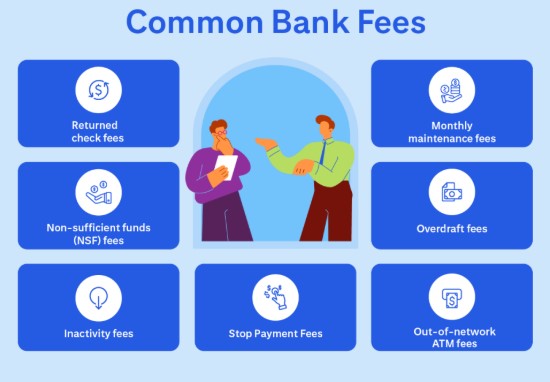
This guide focuses on what customers actually face across bank accounts: monthly maintenance fees, overdraft fees, ATM fees, transfer charges, foreign transaction fees, paper statement fees, and inactivity or minimum balance fees. You might also see search results such as 8 common bank fees and how to avoid them or 7 common banking fees and how to avoid them article. The labels vary, but the same charges appear again and again.
What is bank charges in accounting
When people ask what is bank charges in accounting, they’re usually trying to understand how fees fit into personal budgeting or business bookkeeping. In accounting terms, bank charges are expenses paid to a bank for account-related services. They include monthly service fees, overdraft fees, ATM fees, wire transfer fees, foreign transaction fees, paper statement fees, and other charges tied to transactions. For a business, these fees reduce profits because they are operating costs. For a personal account, they reduce how much money remains available for savings, payments, or everyday spending.
Bank charges also show up as small line items that are easy to ignore. A single “service fee” or “maintenance” charge may not look serious, but repeated charges every month can become a steady drain. This is why many people look for a common bank fees calculator or try to estimate common bank fees per month and average bank fees per month. Once you see the pattern, it becomes easier to change the pattern.
A simple common bank fees calculator approach
A “calculator” does not have to be a fancy tool. The point is to measure what you pay in fees so you can compare banks and change habits. Start by reviewing one month of transactions and listing every fee, charge, or service cost. Add monthly maintenance fees, overdraft fees, NSF fees, ATM fees, wire transfer fees, foreign transaction fees, paper statement charges, inactivity fees, and minimum balance fees. That total is your common bank fees per month for that month.
To get a more realistic picture, repeat this for three months and divide by three. This gives a better estimate of average bank fees per month, since one month might include a one-time wire transfer or a travel period with extra ATM use. People who track this often find that their real monthly fee cost is higher than they expected, especially if multiple “small” charges appear across accounts.
If you’re comparing banks, this method is more honest than comparing marketing claims. A bank may advertise “no monthly fees,” yet you still pay ATM fees, foreign transaction fees, or wire transfer fees. A fee-free headline can hide common hidden costs, which is why searches like common hidden bank fees and common hidden fees in no-fee online banks are so common.
Monthly maintenance fees and monthly service fees
Monthly maintenance fees are one of the most common bank account fees. Many banks charge a monthly maintenance fee or monthly service fee simply for keeping an account open, especially a checking account. Some banks waive the fee if customers meet conditions like direct deposit, a minimum balance, or a certain number of debit card transactions. If you’re wondering what are common banking fees, this category belongs near the top, because it hits customers even when they don’t do anything unusual.
Why this fee happens
Banks treat account upkeep as a service: customer support, statement access, card replacement, branch access, fraud monitoring, and general banking operations. Some banks include these costs by default; others charge a monthly fee unless you meet waiver conditions. This is one reason people search bank of america common fees, because large banks often have clear monthly maintenance structures that vary by account type.
How to avoid it
The simplest way to avoid monthly maintenance fees is to meet the waiver rule that fits your routine. If your income comes in through direct deposit, routing it to the account often removes the monthly fee. If direct deposit is not an option, some accounts waive the fee when you keep a minimum balance.
If neither rule fits your life, consider accounts that do not charge monthly maintenance at all, including many online banks. Still, check the full fee schedule because an account can remove monthly fees while adding higher ATM fees, foreign transaction fees, or transfer charges.
Overdraft fees and NSF fees
Overdraft fees are among the most expensive common banking fees because they are triggered when there isn’t enough money in your account to cover a payment, a check, a debit card transaction, or an automatic transfer. When a bank pays the transaction anyway, you may get an overdraft fee. When the bank declines it, you may still see an NSF fee, depending on the bank’s rules. If someone asks you to name three bank fees commonly associated with checking accounts, overdraft fees are almost always one of the answers.
Why this fee happens
Overdraft fees usually happen because timing is messy. A deposit may arrive later than expected, while a payment goes out earlier than you thought. Subscription charges, automatic bill pay, and small card transactions can also stack up quickly. Some banks also apply overdraft coverage settings that customers do not fully notice at signup.
How to avoid it
Overdraft avoidance starts with awareness. Low-balance alerts help because they warn you before a transaction triggers a fee. Keeping a buffer in checking is another practical option, even if it’s small.
Overdraft protection can help, but it depends on the bank’s policy. Linking a savings account may trigger a transfer when the checking account balance drops, sometimes with a fee. A linked credit line can cover shortages, but interest charges can follow. For most customers, the cleanest approach is a buffer plus alerts plus adjusting bill timing so payments align with deposit dates.
ATM fees and cash withdrawal charges
ATM fees are a classic cost that many customers still pay without realizing how often it happens. With many banks, using an out-of-network ATM triggers a fee from your own bank and also a surcharge from the ATM owner. That’s two separate charges for one withdrawal. This is why people search common hidden bank fees and why ATM fees often show up in any list of bank charges.
International cash withdrawals can be even more expensive. A widely searched example is International ATM withdrawal fee Commonwealth Bank, since international withdrawals can combine ATM fees, foreign transaction fees, and exchange-rate spreads.
Why this fee happens
ATM fees exist because banks pay network costs and also use ATM networks as part of their competitive strategy. Some banks offer broad ATM access, while others push customers toward their own machines or partner networks.
How to avoid it
First, choose in-network ATMs whenever possible. Second, plan withdrawals so you make fewer cash trips. Third, if you use cash regularly, consider a bank account that offers ATM fee reimbursements, which can reduce overall monthly costs. Some people compare options like Schwab Bank because it is often mentioned in discussions about reimbursing ATM fees, especially for travelers.
If you travel, one practical move is to use a card that reduces international fees and withdraw larger amounts less often, while staying mindful of personal safety.
Wire transfer fees and transfer-related charges
Wire transfer fees are common when you move money for large purchases, business payments, or time-sensitive transfers. Many banks charge wire transfer fees for outgoing wires and sometimes for incoming wires too. Wire transfers are fast and final compared to standard transfers, so banks price them higher. This category also overlaps with the phrase fees charged by the bank for common account activities, since transfers are everyday tools for many customers.
Why this fee happens
Wire transfers are processed through systems that require additional verification and handling. Banks also treat wires as premium services because of speed and finality. That’s why wire transfers typically cost more than standard bank transfers.
How to avoid it
If speed is not critical, use standard bank transfers when possible, since they are often cheaper. If you must use wires regularly, compare banks by wire pricing and account type. Some banks waive wire fees for premium accounts, yet premium accounts may carry monthly maintenance fees. That’s where your monthly fee calculation helps, because you can compare the full cost.
If you run a business, ask vendors whether ACH is accepted instead of wire. The difference can save money over time.
Foreign transaction fees and international purchase costs
Foreign transaction fees apply when you use your debit card or credit card with a merchant that processes payments internationally or in a foreign currency. Many banks charge a percentage fee per transaction. People who shop online often get surprised by these fees because they can appear even when you never leave your country, depending on where the merchant processes payments. This is why searches like common fees online banking and common types of bank fees often include foreign transaction fees.
Why this fee happens
Foreign transaction fees cover network processing costs and currency conversion risks. Some banks also add a margin. The customer usually sees the final fee as a single charge attached to the transaction.
How to avoid it
Use a card with no foreign transaction fees, especially if you travel or buy from international merchants often. Many travel-focused credit cards remove these fees. Some bank accounts linked to modern debit cards do as well, but it’s worth confirming the details in the fee schedule.
If you notice a certain merchant triggers these fees repeatedly, switch payment methods for that merchant.
Paper statement fees and documentation charges
Paper statements may feel old-school, yet some customers prefer them for recordkeeping, budgeting, or personal comfort. Many banks now charge for mailed statements, which turns “preference” into a recurring monthly cost. These charges often appear as service fees, making them easy to miss unless you scan your statements carefully.
Why this fee happens
Paper statements involve printing and mailing. Banks often price them to encourage electronic statements, which cost less to provide. Some banks include paper statements in specific account tiers, but many charge per month.
How to avoid it
Switch to electronic statements and download them as PDFs. If you need physical records, print selected pages yourself. This keeps control in your hands and usually costs less than paying recurring paper statement fees.
If you manage business accounts, organize digital statements by month and keep backups. Clear documentation helps with budgeting, taxes, and any disputes that require transaction records.
Inactivity fees, minimum balance fees, and account closure fees
This category often hits customers who are trying to simplify finances. An account that sits unused can trigger inactivity fees, and an account with a low balance can trigger minimum balance fees. Some banks also charge account closure fees if you close an account shortly after opening it. People searching common bank fee in Utah or other location-based phrases often notice these fees vary by bank and region, but the categories remain consistent.
Why this fee happens
Inactivity fees exist because banks do not want to maintain accounts that generate no activity. Minimum balance fees exist because banks want stable deposits. Account closure fees exist because banks want to discourage “account churning,” where customers open accounts only for promos and close quickly.
How to avoid it
If you keep an account, use it regularly, even with a small transaction or transfer. If you do not need it, close it properly, but check timing rules first. For minimum balance fees, either maintain the required balance or choose accounts without minimum balance rules.
For new accounts, review closure terms before signing up. If the bank charges a closure fee within a certain window, wait until the window passes if you plan to close.
Putting it together: 7 common banking fees and how to avoid them
People often search 7 common banking fees and how to avoid them, 7 common banking fees, and even four common bank fees because they want a quick map of what matters. The reality is that fee avoidance depends on your habits. Some customers never use cash, so ATM fees barely matter. Others use ATMs weekly, so that fee becomes a major monthly cost. Some people keep stable balances, so minimum balance fees never trigger. Others run tight monthly budgets, so those fees can appear often.
A useful approach is to identify your top two fee categories, then fix those first. If your problem is overdraft fees, focus on alerts, a buffer, and bill timing. If your problem is ATM fees, focus on in-network ATMs or a bank that reimburses fees. If your problem is monthly maintenance fees, meet waiver rules or switch accounts. This is the practical meaning behind phrases like how to avoid common banking fees, common bank fees and how to avoid them, and the many variations people search.
Extra clarity for common search questions
Many users search list and explain 3 common service fees that banks charge or 3 most common bank fees. The typical “top three” are monthly maintenance fees, overdraft fees, and ATM fees. This also answers questions like three bank fees commonly associated with checking accounts and bank fees commonly associated with checking accounts.
You may also see quiz-style searches like all of these are common banking fees except. Those questions usually include a fake fee category that does not match common fee types.
Some searches mix consumer fees with deal-related advisory fees, such as common debt advising fees investment banking lbo and common equity advising fees investment banking lbo. Those refer to investment banking advisory fees in corporate deals, not everyday checking account fees. The overlap is the word “fees,” yet the topic is different.
Conclusion
Bank fees are predictable once you know the triggers. The most common fees usually come from monthly maintenance rules, overdraft situations, out-of-network ATM withdrawals, wire transfers, foreign transactions, paper statements, and inactive or low-balance accounts. When you track your common bank fees per month with a simple calculation, your banking choices become clearer. Small changes—like switching statement settings, using in-network ATMs, aligning deposits with payments, or choosing a bank with better fee policies—can reduce costs month after month.